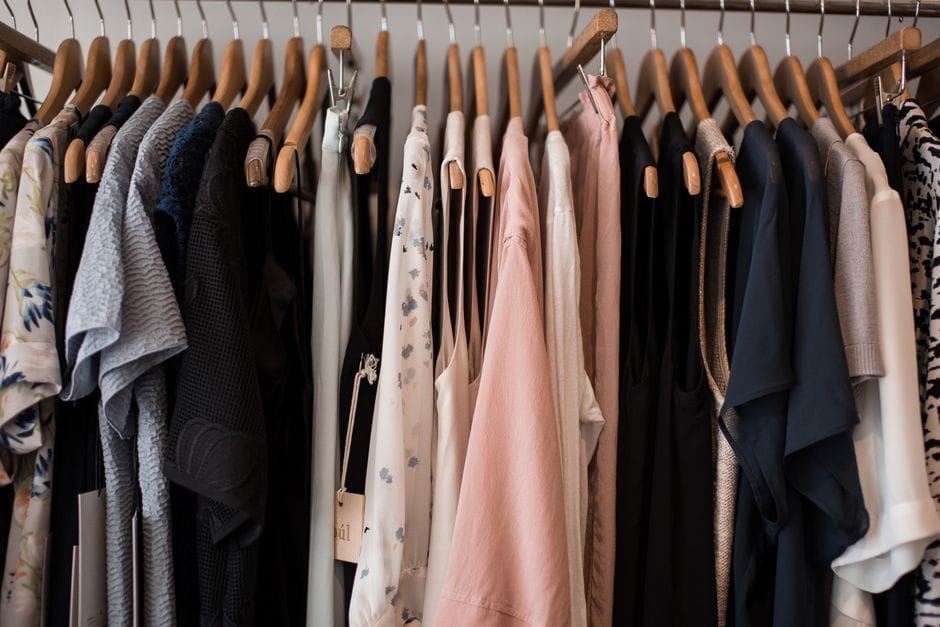
A full wardrobe and nothing to wear is not a personality flaw, it is a maths problem. Most of us own dozens of pieces that do not talk to each other, so getting dressed means assembling an outfit from scratch every single morning. A capsule fixes that by doing the thinking once: a small set of pieces in a tight colour palette, each one able to pair with most of the others. Twelve items is enough for a whole summer if you choose them properly, and the difference on a Monday morning is genuinely calming.
The rule that makes a capsule work
A capsule is not just 'fewer clothes'. It only works if the pieces share a palette, because that is what lets them mix without you thinking about it. Pick two neutrals you actually like — say off-white and navy, or stone and black — plus one colour that flatters you. Everything you buy has to sit inside that palette. The moment you add a mustard skirt that goes with nothing else, you are back to outfit-from-scratch every day.
Buy for the life you actually lead, not the one in the brochure. If you spend your summer doing the school run and the supermarket, you need machine-washable cotton, not three silk slip dresses that need dry-cleaning.
The twelve pieces
Tops (4)
Two plain T-shirts in your neutrals, one linen shirt you can throw over everything, and one going-out top with a bit more interest — a square neckline or a broderie detail. A white tee is where people overthink price: Uniqlo's Supima cotton crew at around £15 holds its shape far better than a £6 multipack and far better than you would expect for the money.
Bottoms (4)
A pair of well-cut denim shorts, tailored linen-blend trousers, one midi skirt, and jeans you can roll at the ankle. The linen trousers are the workhorse here — COS, Arket and M&S all do versions between £35 and £59 that read as smart with sandals and relaxed with trainers.
Dresses and layers (4)
One easy day dress, one dress you can dress up for an evening, a denim or utility jacket for cooler nights, and a lightweight knit for the inevitable English summer that forgets it is summer. That is the full set, and you will wear all twelve far more than the forty things they replace.
How to judge whether a piece earns its place
Before anything goes in the basket, run it through cost-per-wear, which is the only price metric that tells the truth. A £90 linen shirt you wear sixty times across the summer costs £1.50 a wear. A £20 trend top you wear twice costs £10 a wear and then sits in a drawer reproaching you. Cheaper is not the same as better value, and this is the single idea that changes how you shop.
Ask three things of every piece: does it go with at least three things I already own, will I wear it next summer too, and does it fit me now rather than the version of me I am promising to become? If it fails any of those, leave it.
Make it yours, don't make it a uniform
The risk with capsules is that they tip into looking like a uniform. Accessories are the cheap fix — a coloured sandal, a straw bag, a scarf knotted at the neck — and they let the same twelve pieces read differently on a Tuesday and a Saturday. Rotate two or three accessories rather than buying more clothes, and the capsule stops feeling restrictive and starts feeling like a system that quietly works for you.
Where to spend and where to save
A capsule only saves you money if you spend it in the right places, and buying everything cheap or everything expensive both end badly. The rule that holds up: pay for the pieces that do the heavy lifting and take the wear, and economise on the ones that simply fill a gap.
Spend on the items closest to your body and most often worn — well-cut trousers, a jacket, and shoes you will walk miles in. These are where fit and fabric show immediately, and where a cheap version looks cheap by the third wash. A £120 pair of trousers in a proper linen blend will outlast and outclass four £30 pairs that bag at the knee.
Save on the simple, replaceable layers — plain tees, vest tops, the trend piece you fancy for this summer only. A decent cotton tee does not need to cost £60, and the high street does these well. Before you buy anything, run the thirty-second quality check:
- Hold it to the light — if you can see straight through a supposedly opaque top, it will wear thin fast.
- Tug gently at a seam to check the stitching is dense and even, not loose and sparse.
- Scrunch the fabric in your fist and let go; if it stays a mass of creases, it will spend its life looking like it needs an iron.
- And read the care label, because a 'bargain' that needs dry-cleaning is not a bargain at all.
Get the split right and a modest budget stretches into a wardrobe that looks far more expensive than it actually was.
The point of a capsule is not minimalism for its own sake. It is buying yourself ten free minutes every morning and never again standing in front of a full wardrobe feeling like you own nothing. Choose the palette, buy the twelve, and let the maths do the rest.