You leave the apartment at 8:15 in a sleeveless linen dress because the forecast says 94 degrees by noon, and by 9:05 you're digging through your desk drawer for the cardigan you keep there for exactly this reason. This is the part of summer dressing that never makes it into a capsule wardrobe list: the fifteen-minute window between the subway platform and your desk, where the temperature drops by twenty-five degrees and nobody warns you. Office buildings in July run colder than most people's houses in January, and the standard advice — pack light, wear linen, embrace the heat — solves exactly half the problem. By 10 a.m. you're the person visibly shivering in a client meeting while everyone who commuted by car looks perfectly comfortable in a sweater they never had to carry. And by the time you leave at six, the cardigan goes back in the bag, having done nothing for the walk to the train except take up space.
The Wardrobe Problem Every Summer Guide Skips
Commercial HVAC systems are built to a decades-old standard that assumed a room full of men in wool suits, and the underlying formula hasn't changed much since, even though most office floors today are a mix of body types, metabolisms and clothing weights. ASHRAE, the industry body that sets the thermal comfort baseline most US buildings still follow, based its original metabolic-rate formula on a roughly 154-pound man in a full suit — a bias documented in a widely cited 2015 study in Nature Climate Change that measured how much colder standard office settings run for most women than the formula accounts for. The result is thermostats set to 68–70°F in buildings where the sidewalk outside reads 90-plus, and a lot of women showing up in sleeveless dresses because the walk to work demanded it, then freezing through a 10 a.m. meeting. You've felt this. The elevator ride up is the last comfortable five minutes of your day until you're back outside at 6 p.m., and no amount of hot coffee at your desk actually fixes cold shoulders and bare arms. Facilities teams rarely adjust for it either, since the person who controls the thermostat is usually the one least affected by it.
The instinct is to solve it with whatever's on the coat hook — a giant zip-up hoodie, last winter's puffer vest, a boyfriend flannel abandoned by an ex three years ago. None of it works with a linen shift or a slip skirt, and it shows. A structured layer is the better choice here, not because it looks more "professional" in some abstract sense, but because it's cut to sit over fitted or flowy pieces without adding bulk at the shoulder or hip.
Why the Giant Cardigan Isn't the Fix You Think It Is
An oversized cardigan feels like the obvious answer because it's warm and it's already in your closet. Skip it anyway for office days that involve clients, meetings, or anyone above your own level — an oversized knit reads sloppy under fluorescent light in a way it never does at brunch, and the sleeves catch on everything from your laptop bag to the office coffee machine.
Try a fine-gauge cardigan instead, something close-fitted through the body with a clean rib at the cuff and hem. Uniqlo's Extra Fine Merino cardigan runs about $39.90 and holds its shape through a full workweek of on-off-on. Everlane's cotton-cashmere version sits closer to $88 and drapes slightly softer, which matters if you're wearing it over a dress rather than trousers. Both fold down small enough to live in a tote without wrinkling, which the giant hoodie never did.
The Blazer Argument
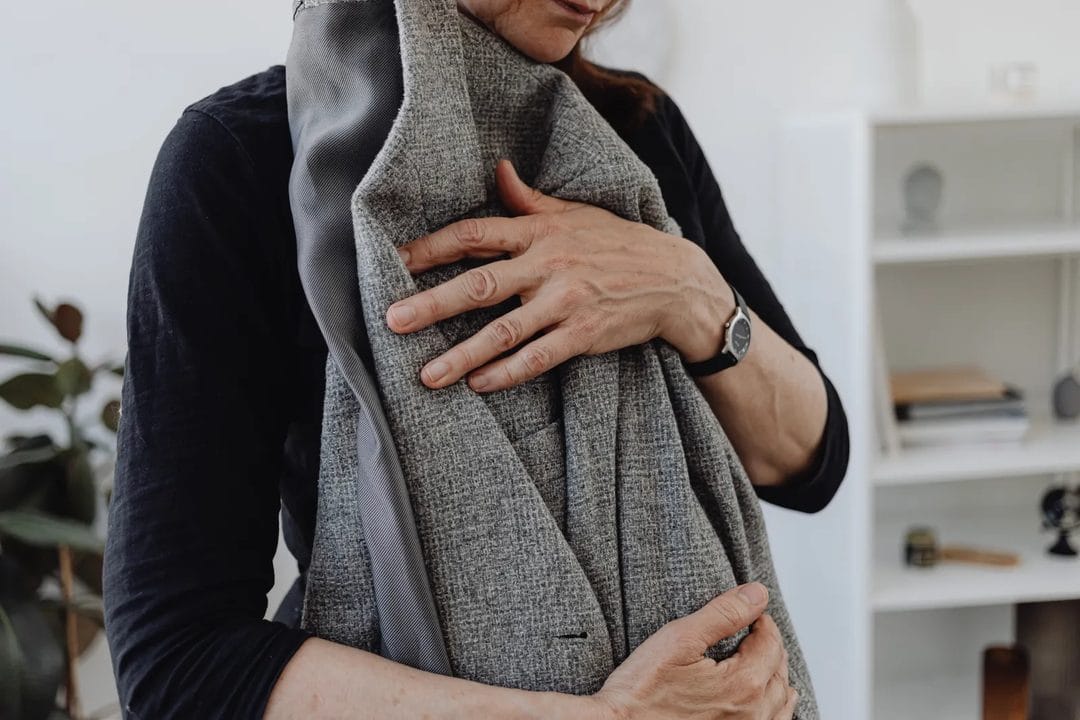
A blazer solves a problem the cardigan can't: it works over almost anything without looking like an afterthought, from a slip dress to wide-leg trousers to a simple tank and skirt. J.Crew's washable wool blazer, around $168, has become the office standard for a reason — it survives a hot commute stuffed in a bag, doesn't wrinkle if you sit in it on the train, and reads finished even buttoned over nothing but a camisole.
If you only buy one layering piece this year, make it this one.
Aritzia's Utility blazer, closer to $228, is boxier and slightly cropped, which works better over higher-waisted trousers than over dresses. COS makes a boiled-wool version around $145 that's warmer than either, useful if your office runs genuinely cold rather than just air-conditioned — there's a real difference between a 72°F floor and one set to 65°F, and you'll know which one you have within your first week. Fit matters more than fabric weight here: a blazer that pulls across the back when your arms are down will feel restrictive by 3 p.m., no matter how breathable the wool is.
What to Wear Underneath, Since That's Half the Equation
A blazer only works as a temperature layer if what's underneath can survive both extremes on its own. A silk or silk-blend camisole is the quiet workhorse here — it reads polished with nothing over it during the AC-blasted hours and doesn't add bulk once the blazer goes on top. Quince sells one for around $38 that gets recommended constantly for exactly this reason. Cotton poplin shirts do similar double duty, though they run warmer once buttoned to the top, so unbutton one more than you'd think is professional and let the blazer do the covering. Avoid anything with a built-in sweater weight underneath a blazer; two insulating layers stacked on top of each other is how you end up sweating through a meeting instead of just being comfortable in one.
Layering Pieces, Ranked by How Often You'll Actually Reach for Them
- Fine-gauge cardigan (Uniqlo, Everlane, Quince) — lives at your desk, works over dresses, slips off in two seconds when a client walks by
- Washable wool blazer — the one piece that upgrades an entire outfit while also solving the temperature problem, worth the $150–$200 it costs at J.Crew or Banana Republic
- A silk or silk-blend scarf, which sounds old-fashioned until you've used one draped over bare shoulders in a freezing conference room and realized it weighs nothing in a bag
- Structured vest — divisive, but genuinely useful under a blazer on the coldest office days, and it doesn't restrict your arms the way a full jacket does
- Denim jacket, mostly for casual Fridays or offices without a strict dress code, since it reads more weekend than boardroom
Not every one of these belongs in every closet, and that's fine — the scarf is the one people skip first, usually right up until the day a coworker asks where they got it.
What Lives at Your Desk Versus What You Wear In
Split your strategy in two. What you wear on the commute needs to survive actual heat — that means the fitted cardigan or a lightweight trench, something you can carry rather than wear once you're past the lobby. What lives permanently at your desk is a different category entirely: a blazer on the back of your chair, or a cardigan folded in a drawer, ready for the days you forget or the days it's colder than usual.
Not every office runs cold, and the exceptions matter. Startups with open floor plans and no individual thermostats tend to run warm, sometimes uncomfortably so, because there are too many people and not enough vents. The freezing-office problem is really a mid-size corporate office problem — the kind with a facilities team, a building-wide setting nobody's allowed to touch, and a temperature that was decided on a spreadsheet years before anyone currently working there was hired. If that's not your office, most of this advice still applies on the commute and in over-air-conditioned restaurants, movie theaters, and the occasional summer wedding reception.
Buy one blazer that fits properly before you buy anything else on this list. Get it tailored if the sleeves run long — a $20 alteration at a local tailor makes a $168 blazer look like it cost three times that, and it'll outlast every trend piece you buy this summer. Keep a cardigan at your desk as backup, keep the scarf in your bag for the days you didn't expect, and stop treating the walk from your apartment to your desk as the only temperature that counts.