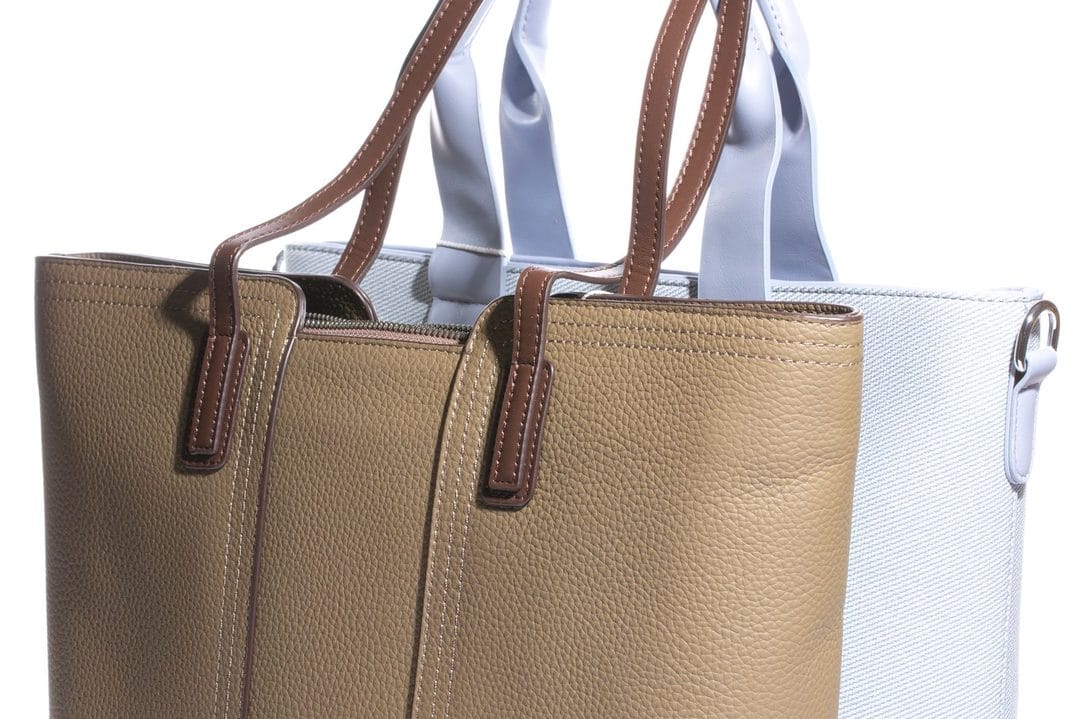
Somewhere around the second week of September, the tote that's been slumped against your desk chair since May starts to look wrong. Not dirty, not damaged — just soft in a season that's asking for something with a spine. The slouchy shoulder bag that carried sunscreen and a paperback all summer suddenly reads as an afterthought next to a blazer, and the shift isn't really about the bag itself. It's about what a bag is supposed to signal once the rest of the wardrobe stops being casual by default.
Structured totes — boxy, hard-cornered, sitting upright on a table instead of pooling into a puddle of leather — are having the kind of quiet, unannounced takeover that doesn't show up as a trend piece until it's already happened in half the closets on your street. Cuyana's System Tote, priced around $248, has become the bag a coworker mentions offhand and three other people ask about within the week. Polène's Numéro Un, a structured top-handle that runs around $390, looks like it costs closer to $900 — the kind of price-to-appearance ratio that gets a bag repeat-purchased in a second color once the first one earns its keep. None of this is accidental, and it isn't really about the bags being new designs either, since most of these silhouettes have existed in some form for years. Unstructured totes had their moment precisely because they photographed as effortless, but "effortless" and "functional for a nine-hour day" turned out to be two different promises. It's a direct response to two years of slouchy, unstructured "quiet luxury" bags that, once the novelty wore off, mostly just looked like they'd given up on holding their own shape.
Why now, and not last fall
Part of it is simple pendulum swing — fashion rarely lets one silhouette dominate for more than three or four seasons before reversing course, and the unstructured tote has had its run since roughly 2023. But the more useful explanation is practical: a structured bag holds a laptop upright without the corners denting your ribs, keeps a water bottle from tipping sideways into your only clean blouse, and doesn't collapse into a shapeless heap the second you set it down at a coffee shop table. Slouchy bags photograph beautifully draped over one shoulder in a studio shot. They perform badly on a Tuesday when you're switching from a train to a meeting to a dinner without going home to swap bags in between.
September specifically is when that mismatch becomes impossible to ignore. School schedules restart, offices that went casual in July tighten back up, and the bag that worked fine for a beach bag in June now has to do the job of briefcase, laptop bag, and evening bag inside the same eight hours. A soft tote simply can't hold that shape-shifting workload the way a structured one can — ask it to be sleek at 9am and slightly dressed-up at 7pm, and the slouchy version just looks tired by hour three.
What "structured" actually means (it's not stiff)
The word conjures something corporate and boxy in a bad way — think a 2009 briefcase-tote hybrid nobody missed. That's not what's selling now. The current version keeps hard corners and a defined base but softens everything else: rounded top edges, buttery leather that still creases naturally, straps with a little give. Madewell's Zip-Top Transport Tote, at $168, is the accessible version of this — structured enough to stand on its own, soft enough not to look like it belongs in a boardroom from a decade ago. COS runs a similar silhouette in the $135–$175 range depending on the leather grade, and it's become the unofficial uniform bag for a specific type of Substack-reading, oat-milk-latte office worker in every major city. Both brands lean on vegetable-tanned or lightly pigmented leather rather than the heavily coated, plasticky finish that made mid-2010s structured bags feel disposable within a year.
Skip anything described as "structured" that's actually just stiff, unyielding vegan leather holding a shape through rigidity rather than good construction — you'll know within two wears because it won't soften at all, and a bag that can't relax slightly with use was never built to last past one season.
The totes worth actually buying this season
At the top end, Polène's Numéro Un ($390) and Mansur Gavriel's Tulipano tote (around $495) are the two everyone's watching, both because they photograph like they cost twice as much and because the leather on both ages into something better than new within a year of regular use. Staud's Shirley bag ($375) sits in a similar tier with a slightly more architectural, almost sculptural base that reads younger and less "investment piece."
The mid-tier is where most people should actually be shopping. Madewell's Transport Tote and COS's structured leather tote both land under $200, hold a 13-inch laptop without straining the base seam, and come in colors — a rust, an olive, a genuinely useful black — that work through winter once the rest of the wardrobe darkens. Telfar's Shopping Bag, priced between $150 and $257 depending on size, occupies its own category entirely: technically a tote, structured through consistent shape rather than stiff leather, and one of the only bags in this price range that reads as a specific cultural signifier rather than just an accessory.
- Cuyana System Tote — $248, the one most likely to already be in a coworker's rotation
- Madewell Zip-Top Transport Tote — $168, best laptop-to-dinner crossover under $200
- Polène Numéro Un — $390, worth it if you'll wear it four days a week for three years
- Telfar Shopping Bag (Medium) — $202, structured through shape rather than stiffness, genuinely unisex
- And for anyone not ready to spend three figures at all, Uniqlo's canvas structured tote at $39.90 gets the silhouette right even if the leather versions age better
What to retire, and what earns a stay of execution
Not every slouchy bag deserves to get boxed up. This is where most style advice oversimplifies — treating a whole category as suddenly obsolete rather than admitting some pieces still do a job nothing else does. A soft, unstructured tote is still the right call for travel days, when you need a bag that compresses to fit under an airplane seat and doesn't care about getting stuffed under a jacket in an overhead bin. Longchamp's Le Pliage, the nylon fold-flat tote that's been a travel staple since 1993, isn't going anywhere, and buying a rigid structured bag specifically for a red-eye flight is solving a problem you didn't have.
What's actually worth retiring is the everyday version — the bag doing double duty as commuter bag, work bag, and errand bag, which is exactly the role a structured tote does better. If your slouchy bag has been stretched out of shape by a laptop it was never built to carry, that's the specific sign to replace it, not a vague sense that trends have moved on.
How to wear it without it looking like a costume
The mistake people make with a new structured tote is treating it like a formal statement piece that needs an equally formal outfit around it. It doesn't. A structured tote in a neutral tone — tan, black, a deep olive — works over jeans and a t-shirt exactly the way the slouchy version did; the structure changes how the bag holds up over a nine-hour day, not what it's allowed to be worn with. Carry it by the top handle for a slightly dressed-up look at a client meeting, then switch to the shoulder strap on the walk home and it reads completely differently without you doing anything except changing your grip.
Where this actually breaks down is fit with the rest of the outfit's silhouette. A very structured, boxy tote next to very boxy, oversized tailoring can start to look like two rigid shapes fighting each other rather than complementing. Pair the structured bag with something that has movement elsewhere — a slightly flowy trouser, a soft knit — and the whole outfit reads as considered instead of accidentally matchy.
The budget math, honestly
A $168 Madewell tote used four days a week for two years works out to roughly 40 cents a wear, which is a better number than most people run for shoes they spent half as much on. The $390 Polène only beats that math if it genuinely gets carried three-plus times a week for several years, not left on a shelf for special occasions — a structured tote is only doing its job if it's the bag you reach for without thinking, and one that's too precious to actually use has failed at that regardless of how good the leather is.
Buy for the version of September you actually have, not the one on a moodboard. If most days involve a laptop, a water bottle, and a fast walk between two trains, the $168 option that can take a scuff without you flinching wins over the $390 one every time.